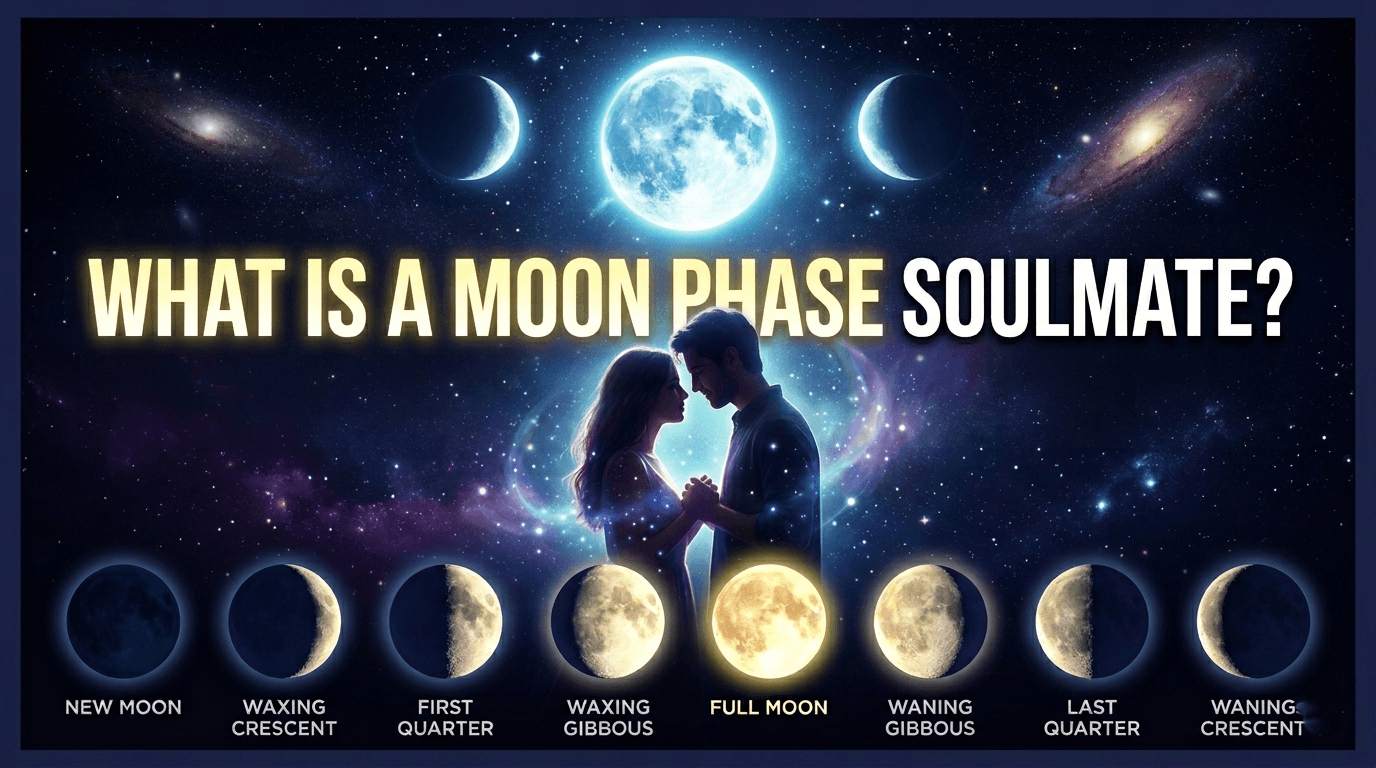
What is a moon phase soulmate?
A moon phase soulmate is a person whose lunar birth phase — one of eight phases from New Moon to Waning Crescent — forms a complementary or opposing relationship with your own.
The concept holds that people born under phases separated by 120° (trine) or 180° (opposition) on the 29.5-day lunar cycle experience the deepest emotional attunement and romantic polarity.
Compatibility is measured by the angular gap between two people’s birth moon phases, with opposite pairings like New Moon + Full Moon historically scoring highest.
Introduction
You’ve seen the TikTok filter. Maybe you’ve held your phone up next to someone else’s and watched two half-moons lock together into a perfect circle. It feels like fate — and for millions of people, that feeling sparks a real question: Is there actually something to this?
Moon phase compatibility isn’t a new idea. Long before social media made it viral, astrologers, psychologists, and spiritual traditions recognized that the moon’s phase at the moment of your birth leaves an emotional imprint — shaping how you love, how you argue, how you need to be held, and how you pull away when you’re hurting.
This guide is for people who want more than a filter result. We’ve broken down the full science and symbolism:
- ✦ What each of the 8 lunar phases means for your personality and love style
- ✦ How compatibility is actually calculated (with real angular measurements)
- ✦ Which pairings work best for romance, friendship, and long-term commitment
- ✦ What to do when your phases clash instead of click
Whether you’re a New Moon searching for your Full Moon mirror, or two Waning Crescents content in quiet companionship, understanding lunar compatibility can become one of the most useful communication tools in your relationship.
Quick Insights: Moon Phase &; Compatibility FAQ
❓ What is a moon phase soulmate?
A person born under a moon phase that harmonizes with yours — same phase, opposite, or a 60°/120° angle — creating stronger emotional resonance and complementary energy.
🌙 How do I find my moon phase?
Use a moon phase calculator with your exact birth date, time, and location. Birth time matters — a few hours near a phase boundary can change your result.
✨ Best compatibility pairing?
New Moon + Full Moon (180° opposition) is classically the strongest — magnetic polarity and emotional balance.
🤝 Can friends be moon phase soulmates?
Yes. Many lifelong friendships and business partnerships are trine (120°) or sextile (60°) pairings — effortless and mutually supportive.
📱 Is the TikTok filter accurate?
It’s a fun starting point but uses only your birth date, not time or location. For precision, always use a full birth chart calculator.
The 8 Moon Phases and What They Say About You
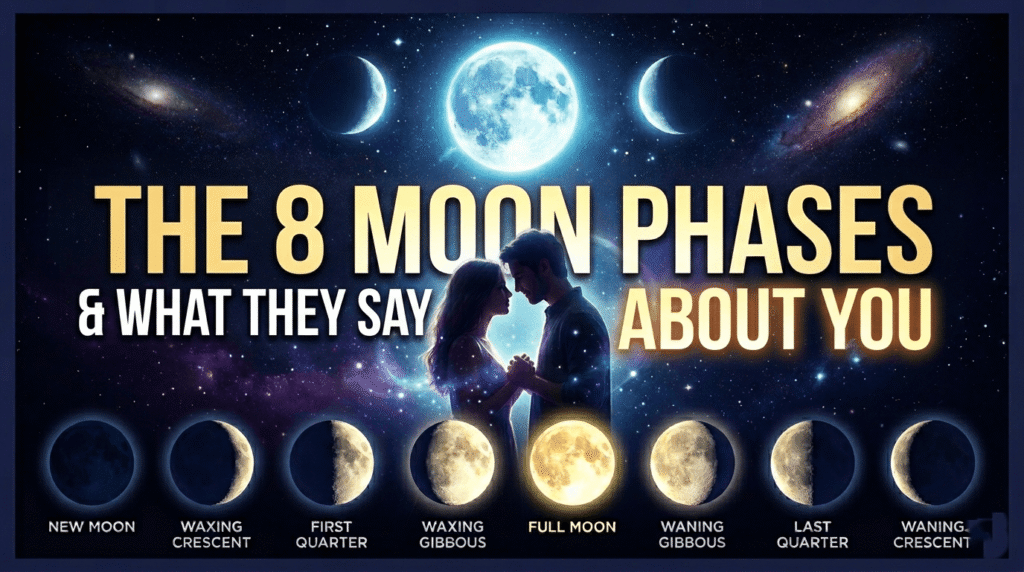
Your moon phase is determined by the angular distance between the Sun and Moon at your exact moment of birth. That gap creates a distinct emotional blueprint — one that shapes how you process feelings, build trust, and experience love.
Here is a full breakdown of all eight phases:
| Moon Phase | Symbol | Core Personality Trait | Love Style | Shadow Side |
|---|---|---|---|---|
| 🌑 New Moon | Seed, beginning | Visionary, introspective, patient | Quiet and intuitive; slow to open up but deeply loyal once they do | Indecisive, tends to retreat when overwhelmed |
| 🌒 Waxing Crescent | Sprout, determination | Hopeful, resilient, future-focused | Builds love steadily and with purpose; optimistic partner | Can be stubborn; sometimes rushes into plans |
| 🌓 First Quarter | Action, tension | Courageous, direct, driven | Passionate and confrontational; loves deeply and argues equally hard | Impulsive; dislikes emotional ambiguity |
| 🌔 Waxing Gibbous | Refinement, adjustment | Analytical, caring, detail-oriented | Thoughtful and attentive; expresses love through acts of service | Can become critical or anxious when things feel imperfect |
| 🌕 Full Moon | Illumination, climax | Charismatic, emotionally generous | Dramatic, warm, gives everything in love; needs to feel seen | Over-emotional at times; can swing between highs and lows |
| 🌖 Waning Gibbous | Gratitude, sharing | Wise, nurturing, mentor energy | Supportive and devoted; shows love through guidance | Can slip into over-giving or become preachy |
| 🌗 Last Quarter | Release, crisis | Honest, decisive, freedom-loving | Direct communicator; values independence and depth equally | Blunt to a fault; may struggle with long-term vulnerability |
| 🌘 Waning Crescent | Rest, surrender | Dreamy, spiritual, introspective | Gentle and mystical in love; needs space and spiritual alignment | Can become unfocused or avoidant under pressure |
Real-world example: A New Moon person often starts multiple passions at once but struggles with follow-through. They thrive alongside a Waxing Gibbous or Full Moon partner who brings structure and accountability — not by controlling them, but by celebrating small wins along the way.
How Moon Phase Compatibility Is Calculated
Compatibility is rooted in geometry. The lunar cycle spans 360°, and your birth phase sits at a specific point on that circle. When you compare two people’s phases, the angular gap between them tells you the nature of their dynamic — not just whether it’s “good” or “bad,” but what kind of energy it generates.
There are five primary compatibility zones:
| Angular Gap | Aspect Name | Compatibility Score | Relationship Vibe | Example Pairing |
|---|---|---|---|---|
| 0° | Conjunction (same phase) | 75% | Mirror energy — deep recognition, risk of stagnation | New Moon + New Moon |
| 60° | Sextile | 85% | Mentor dynamic — supportive, growth-oriented, harmonious | Waxing Crescent + Waning Gibbous |
| 90° | Square | 65% | Catalyst — productive friction, karmic tension, transformation | First Quarter + Last Quarter |
| 120° | Trine | 88% | Natural flow — easy emotional rhythm, minimal drama | New Moon + Waxing Gibbous |
| 180° | Opposition | 92% | Completer — magnetic polarity, the classic soulmate pull | New Moon + Full Moon |
Important nuance: A lower score does not mean a relationship is doomed. Square (90°) pairings are among the most transformative — partners push each other toward growth they would never reach alone. The friction is not incompatibility; it is acceleration.
Same-phase couples share a mirror-like emotional world. This can feel profoundly validating, but without the polarity of a different energy, the relationship may amplify both strengths and blind spots equally.
Romantic Compatibility — Passion, Polarity, and Long-Term Love
Romantic attraction in moon phase astrology is largely driven by polarity. The most electrically charged pairings are opposites — two people whose phases sit across the lunar cycle from each other.
New Moon + Full Moon (180°) is the archetypal pairing. The New Moon person brings quiet introspection and seeds of potential. The Full Moon person brings emotional radiance and the need to illuminate everything. Together, they complete each other in a literal sense — their phases join to form a full circle.
Best pairings for different relationship goals:
- Passion and magnetic attraction: Full Moon + New Moon — electric tension, deeply transformative
- Steady, appreciative love: Waxing Gibbous + Waning Gibbous — attuned, grateful, service-oriented
- Building a life together: New Moon + Waxing Crescent — patient dreamers who execute, ideal for long-term projects or raising children
- Intellectual and spiritual depth: Waning Crescent + Waxing Crescent — complementary pacing, one releases, one renews
A note on same-phase marriages: Two Last Quarter moons, for example, both value freedom and honesty — but may both resist being the one who commits or compromises first. The fix is not to become different people; it’s to create structured agreements: alternate who holds the decision-making role, and invite perspectives from trusted people with different phase energies when you feel stuck.
Friendship and Family Compatibility
Moon phase soulmates are not only romantic. Some of the most powerful lunar connections exist between friends, siblings, or colleagues.
Top friendship pairings:
- Waxing Crescent + Waxing Crescent — two optimists who actually follow through on plans. Rare and valuable.
- Full Moon + Waning Gibbous — one celebrates loudly; the other appreciates deeply. A naturally harmonious dynamic.
- New Moon + Last Quarter — the quiet idealist and the honest truth-teller. They balance each other’s blind spots.
Parent-child example: A Waxing Gibbous parent tends toward refinement and structure. A First Quarter child is action-driven and impulsive. The friction here is real — but when the parent channels that energy into goal-setting rather than correction, the child thrives and the parent discovers a new kind of patience.
In professional relationships, trine (120°) and sextile (60°) pairings consistently report the easiest collaboration — shared emotional pacing, natural trust, and complementary thinking styles.
Communication Styles — Talker vs. Processor
One of the most practical applications of moon phase compatibility is understanding how your partner processes and expresses emotions.
Talker phases — Full Moon, Waxing Gibbous, First Quarter — need to speak feelings aloud immediately. They process through conversation. Silence after conflict feels like abandonment.
Processor phases — New Moon, Waning Crescent, Last Quarter — need quiet and internal space before they can articulate anything clearly. Being pushed to speak before they’re ready shuts them down completely.
Balanced adapters — Waxing Crescent, Waning Gibbous — can flex between both modes depending on the relationship.
Conflict tip for opposite pairings (e.g., New Moon + Full Moon):
Use the 20-minute protocol. When conflict arises:
- The Processor (New Moon) takes 20 minutes completely alone — no screens, no talking.
- The Talker (Full Moon) writes down their feelings during this time — getting them out without flooding their partner.
- After 20 minutes, they come back and exchange what they’ve written.
This single practice eliminates the most common breakdown in opposite-phase pairs: emotional flooding on one side and emotional shutdown on the other.
Emotional Safety — Which Pairings Feel Like Home
Emotional safety is distinct from attraction. You can be magnetically drawn to someone and still feel fundamentally unsafe with them — and vice versa.
| Safety Level | Pairing Type | Why It Feels That Way |
|---|---|---|
| High | Trine (120°), Sextile (60°) | Natural emotional pacing; neither person constantly adjusts to the other |
| Medium | Opposition (180°) | Deeply magnetic but requires conscious bridging of different processing styles |
| Variable | Conjunction (0°) | Can feel like profound mirroring or like being stuck in an echo chamber |
| Challenging | Square (90°) | Genuine friction; misread as incompatibility but is actually a growth catalyst |
If your relationship consistently feels anxious or draining, check the phase gap. Square couples frequently mistake productive tension for fundamental incompatibility and exit relationships that had real long-term potential.
Practical tool: Keep a shared “feelings jar.” Each partner writes one unexpressed emotion per day on a slip of paper and drops it in the jar. Once a week, read them together without responding immediately. Over time, this builds emotional vocabulary and reduces the buildup that leads to explosive conflict.
Moon Phase Soulmate vs. Twin Flame — Key Differences
These two concepts are frequently confused, but they describe fundamentally different dynamics.
| Aspect | Moon Phase Soulmate | Twin Flame |
|---|---|---|
| Core purpose | Complementary growth and emotional harmony | Intense mirror reflection, often involving separation and reunion cycles |
| Emotional intensity | Moderate to high — sustainable over time | Extremely high — often destabilizing, at least initially |
| Typical arc | Stable partnership or a deeply instructive relationship | Runner-chaser pattern; may involve multiple reunions and separations |
| Astrological basis | Angular gap between birth moon phases (0°–180°) | Often linked to same or opposing lunar nodes in the birth chart |
| Long-term outcome | Partnership, lasting friendship, or mutual growth | Resolution through reunion — or conscious release |
Not every intense relationship is a twin flame. Many connections that feel fated and overwhelming are simply high-friction moon phase pairings — squares or conjunctions — that contain enormous growth potential if both people are willing to do the inner work.
What Astrology Actually Says — And What It Doesn’t
Moon phase compatibility is a framework, not a verdict. Astrology does not determine who you love or whether a relationship succeeds. What it does is give you a precise, symbolic language for understanding emotional temperament, pacing, and need.
Professional astrologers consistently make two points about moon phase work:
First, the birth moon phase is one layer among many in a full chart. Your sun sign, Venus placement, rising sign, and the synastry between two full charts all add nuance. A New Moon + Full Moon pairing with clashing Venus signs will not automatically be blissful.
Second, awareness transforms compatibility. A couple who understands that one partner is a Processor and one is a Talker, and builds real communication practices around that difference, will consistently outperform a “perfect” pairing where neither person reflects on their emotional patterns.
The moon phase tells you where to look. What you do with what you find is entirely up to you.
Quick Self-Check Before You Open a Calculator
Before you search your birth date, answer these three questions honestly:
- Do your emotional processing speeds feel roughly aligned — or does one person always feel like they’re waiting for the other to catch up?
- When conflict happens, do you both move toward resolution at the same pace?
- Does one of you consistently need solitude while the other needs closeness — and have you found a way to negotiate that without resentment?
If you answered “no” to any of these, a square or opposition gap is likely present. Both are workable — but they require explicit communication about emotional pacing, not just good intentions.
See our full conflict resolution guide for opposite moon phases for practical tools.
Frequently Asked Questions
1. What is a moon phase soulmate in simple terms?
A moon phase soulmate is a person whose lunar phase birth creates a natural emotional harmony or productive polarity with yours — leading to deeper understanding, stronger attraction, or significant personal growth.
2. How do I find my moon phase soulmate?
Use a moon phase birth calculator that requires your birth date, time, and location. Compare your result with another person’s. Look for 180° (opposition) or 120° (trine) gaps for the highest compatibility scores.
3. Can you have the same moon phase as your soulmate?
Yes. Same-phase (conjunction) pairings score around 75% — not the highest, but deeply meaningful. They create intense mirroring: shared instincts, similar processing styles, and profound mutual recognition. The risk is that without polarity, both partners may amplify the same blind spots.
4. Is the TikTok moon phase filter accurate?
It’s accurate for the calendar date, but it ignores birth time and location — both of which can shift your moon phase by up to two days, especially if you were born near a phase transition. For precision, always use a full birth chart tool.
5. What if our phases don’t form a complete circle?
That’s completely normal. Only 4 out of 28 possible pairings produce the classic 180° opposition. Trine, sextile, and even square pairings carry their own depth and value — the goal is understanding your dynamic, not matching a filter.
6. Does birth time matter for moon phase compatibility?
Yes, significantly. Near phase boundaries, a difference of just a few hours can change your phase entirely. Always use your exact birth time for the most accurate result.
7. What’s the difference between a moon phase soulmate and a twin flame?
A twin flame is an intense mirror-soul connection characterized by reunion and separation cycles, often destabilizing. A moon phase soulmate is a broader compatibility framework — more accessible, more sustainable, and more practically useful for building a real relationship.
8. Why did a moon phase soulmate relationship end?
Compatibility is one factor among many. Unhealed attachment wounds, incompatible life goals, poor communication habits, or simply different readiness for commitment can end any relationship regardless of phase alignment. Use the ending as information, not as evidence the framework is broken.
9. Can your moon phase change?
Your birth moon phase stays fixed for life. However, astrologers also use a “progressed moon” — a calculation that moves your moon phase forward in time, shifting approximately every 2.5 years. Your progressed phase adds a current-life layer to your birth moon, showing what emotional themes are most active for you right now.
10. Are moon phase soulmates only romantic?
No — and this is one of the most underappreciated aspects of the concept. Many people’s most transformative moon phase connections are platonic: a best friend, a mentor, a creative collaborator, or a sibling whose energy perfectly complements theirs.
Conclusion
A moon phase soulmate is not a guarantee. It’s a lens.
Used well, it helps you understand why certain people feel immediately familiar, why some relationships require enormous effort while others flow effortlessly, and why you and your partner might experience the same conflict in completely different emotional languages.
Whether you’re a New Moon just beginning your search, a Full Moon who loves with everything you have, or a Waning Crescent who needs stillness and space before connection — there is a phase pairing that speaks to your specific emotional world.
Your next step: find your moon phase using our free calculator, then explore the detailed compatibility guide for your specific pairing. The stars incline. They don’t compel. What you build with what you learn is yours entirely.
Written and reviewed by the editorial team at moon-phase-compatibility.com. Last updated June 2026.
1 thought on “What Is a Moon Phase Soulmate? | Lunar Compatibility & 8 Phase Meanings”